Glutathione
Glutathione (GSH; CAS 70-18-8; MW 307.3 g/mol) is the primary intracellular antioxidant tripeptide (Glu-Cys-Gly) essential for oxidative stress research, detoxification studies, immune function, and mitochondrial protection. Its unique gamma-glutamyl linkage provides enzymatic stability while the cysteine thiol group enables redox cycling between reduced (GSH) and oxidized (GSSG) forms. Glutathione functions as a direct ROS scavenger, cofactor for detoxification enzymes, and regulator of cellular redox status. The 1500mg quantity supports extensive research protocols examining antioxidant defense systems, redox signaling pathways, and cytoprotective mechanisms across multiple experimental applications.
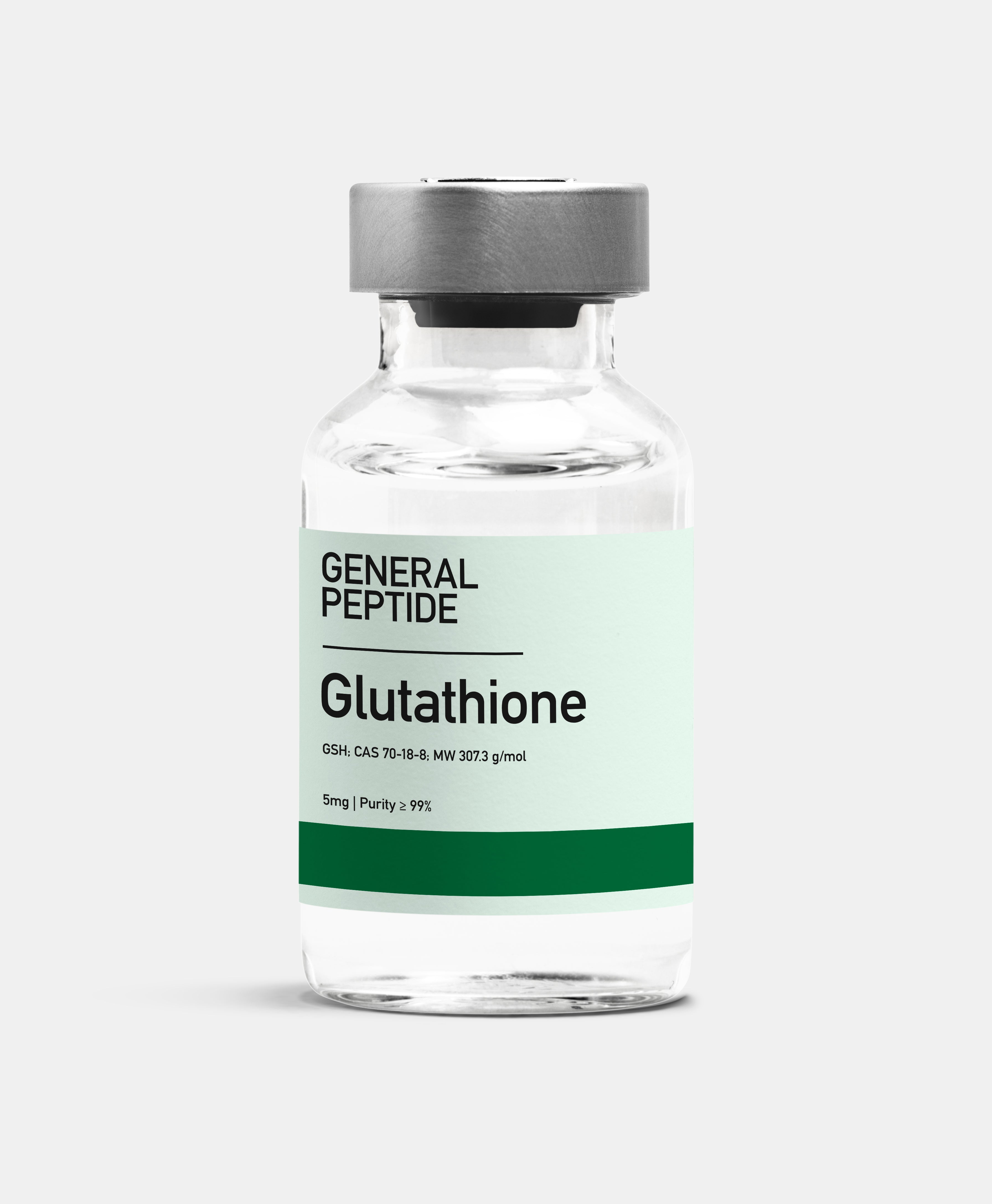
Reduced glutathione (GSH; CAS 70-18-8; MW 307.3 g/mol) is the primary intracellular antioxidant tripeptide (Glu-Cys-Gly) central to oxidative stress research, detoxification pathway investigation, immune cell function, and mitochondrial protection studies. The 1500mg vial size supports comprehensive multi-protocol research applications requiring robust antioxidant capacity.
Glutathione functions as the cell's master antioxidant, existing in high concentrations (millimolar range) within virtually all cells. Its unique gamma-glutamyl linkage provides resistance to standard peptidases, allowing it to maintain stability in the intracellular environment. The cysteine thiol group serves as the active redox center, cycling between reduced (GSH) and oxidized (GSSG) forms to neutralize reactive oxygen species (ROS) and maintain cellular redox homeostasis.
In research applications, glutathione is essential for studying oxidative stress responses, phase II detoxification enzyme activity, and cellular defense mechanisms. It serves as a critical cofactor for glutathione peroxidases and glutathione S-transferases, enzymes that detoxify peroxides and electrophilic compounds. The GSH:GSSG ratio is a widely accepted biomarker of cellular oxidative stress and redox status.
Glutathione's roles extend beyond direct ROS scavenging to include regulation of cell proliferation, apoptosis, immune function, and mitochondrial integrity. It maintains protein thiol groups in their reduced state, protecting against oxidative damage and preserving enzymatic function. The 1500mg quantity provides sufficient material for extensive research protocols examining antioxidant defense systems, redox signaling, and cytoprotective mechanisms.
| Compound | MW / Formula | CAS No. | Sequence / Structure | Receptor / Target |
|---|---|---|---|---|
| Glutathione (GSH) | C10H17N3O6S / 307.3 g/mol | 70-18-8 | Glu-Cys-Gly (gamma-glutamyl linkage) | Primary intracellular antioxidant; ROS scavenger |
The following compounds operate through distinct, non-overlapping mechanisms that complement this product's research pathways. Each is independently available from the General Peptide catalog.
NAD+ is a vital dinucleotide coenzyme present in all living cells, central to cellular energy, DNA repair, and signaling. It fuels ATP production and acts as the rate-limiting substrate for Sirtuins, PARPs, and CD38 enzymes. Because NAD+ levels...
MOTS-c is a unique 16-amino acid peptide encoded by the mitochondrial genome rather than nuclear DNA. It functions as a potent metabolic regulator and "exercise mimetic" by translocating to the nucleus to activate AMPK, optimizing cellular ener...
SS-31 (Elamipretide; D-Arg-Dmt-Lys-Phe-NH2; CAS 736992-21-5; MW 639.8 g/mol) is a D-amino acid tetrapeptide that selectively targets the inner mitochondrial membrane through electrostatic interaction with cardiolipin. Accumulating at ~10,000x g...
BPC-157 (Body Protection Compound-157) is a 15-amino acid pentadecapeptide that functions as a potent systemic protector. Exceptionally stable, it activates VEGF/VEGFR2-Akt-eNOS angiogenic signaling, modulates the nitric oxide system, and provi...
Epithalon is a highly stable synthetic tetrapeptide modeled after a natural pineal gland polypeptide. It functions as a potent telomerase activator and bioregulator, working to elongate telomeres, extend cellular replicative lifespan, and norma...