GHK-Cu (Copper Peptide)
GHK-Cu is a naturally occurring tripeptide-copper complex that acts as a powerful genetic modulator, influencing over 4,000 human genes related to tissue repair and anti-aging. It functions by activating matrix metalloproteinases (MMPs) and stimulating collagen, elastin, and glycosaminoglycan synthesis via the TGF-beta pathway, creating a balanced environment for extracellular matrix (ECM) remodeling and angiogenesis.
Key Research Highlights
- ECM Remodeling: Activates MMP-2/MMP-9 and upregulates TIMPs to rebuild structural tissue scaffolds and stimulate collagen and elastin production.
- Genetic Modulation: Upregulates genes for tissue repair, VEGF-driven angiogenesis, and antioxidant defense while downregulating inflammatory markers.
- Synergistic Stacking: Forms the "GLOW stack" when combined with BPC-157 and TB-500, and pairs effectively with IGF-1 LR3 and Epithalon for comprehensive structural repair.
- Verified Quality: 50mg blue-green lyophilized powder confirming intact Cu2+ chelation, ≥99% HPLC purity, ISO 17025 verified.
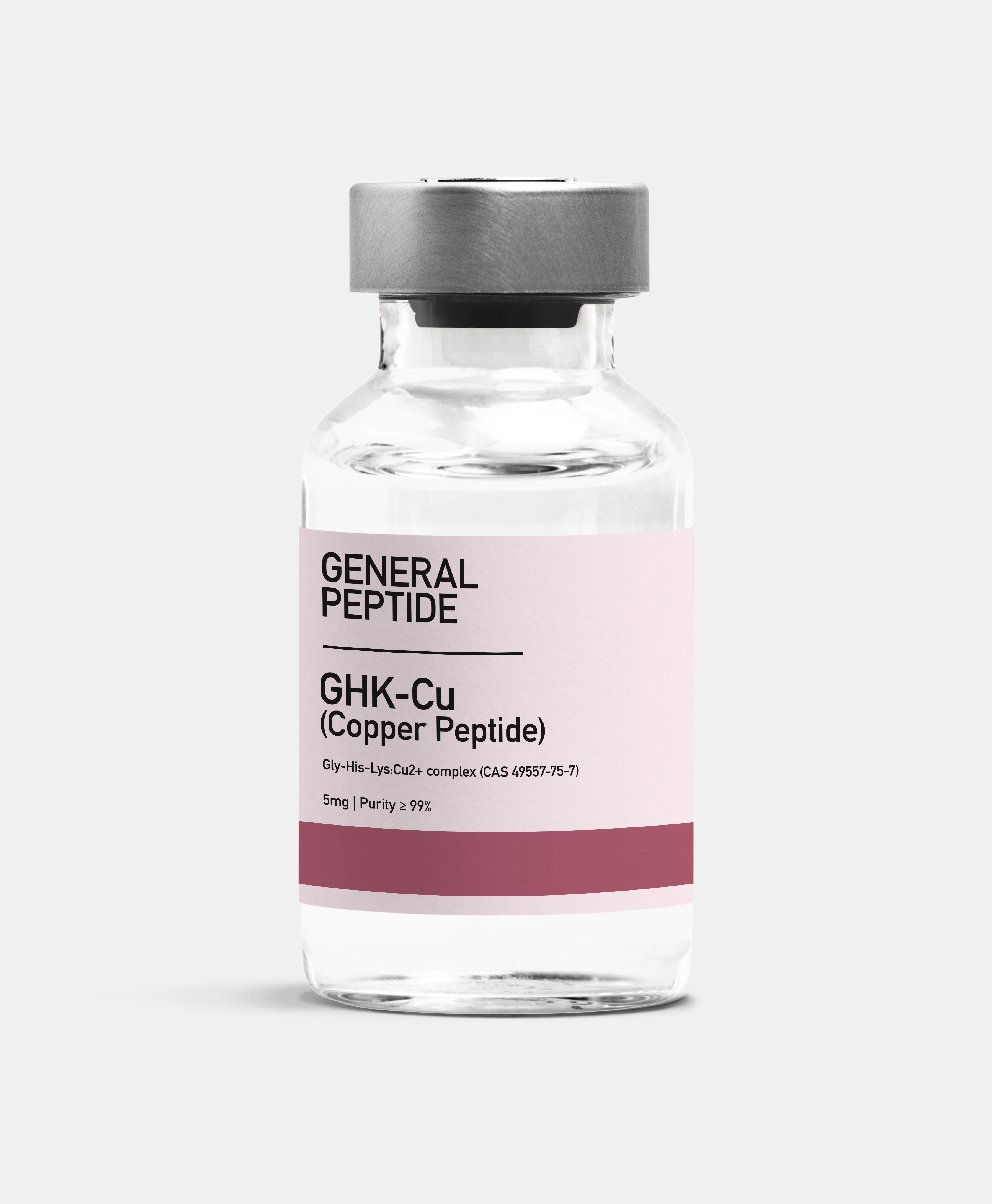
GHK-Cu (CAS 49557-75-7; MW 403.9 g/mol as Cu complex; C14H23CuN6O4) is a naturally occurring tripeptide-copper(II) complex first identified in human plasma albumin by Dr. Loren Pickart in 1973. This simple three-amino acid sequence — Glycine-Histidine-Lysine — forms a stable, high-affinity chelate with cupric ions (Cu2+) via coordination through the histidine imidazole ring and both terminal amines, creating a complex with distinct biological properties that neither the free peptide nor copper ions alone possess.
Despite its small size, GHK-Cu has been documented to influence gene expression across a remarkably broad biological range. Gene expression analyses have shown GHK-Cu modulating over 4,000 human genes — upregulating genes associated with tissue repair, collagen synthesis, angiogenesis, antioxidant defense, and anti-inflammatory response, while downregulating genes linked to cancer progression, inflammation, and oxidative stress.
At the mechanistic level, GHK-Cu operates through several converging activities: it activates matrix metalloproteinases (MMP-2 and MMP-9) while upregulating their inhibitors (TIMP-1 and TIMP-2), creating a balanced ECM remodeling environment. It stimulates collagen, elastin, and glycosaminoglycan synthesis via TGF-beta pathway engagement. Proangiogenic effects operate through VEGF upregulation and nerve growth factor (NGF) production. Antioxidant activity is mediated through copper-dependent SOD activation and NF-kB downregulation.
The 50mg vial format reflects GHK-Cu broader utility in research — applications extend beyond injectable models to topical formulation preparation, high-throughput cell culture experiments, and multi-animal studies requiring substantial total compound quantities.
| Compound | Formula | MW | CAS No. | Sequence / Structure | Receptor / Target |
|---|---|---|---|---|---|
| GHK-Cu | C14H23CuN6O4 | 403.9 g/mol (Cu2+ complex) | 49557-75-7 | Gly-His-Lys chelated with Cu2+ ion | Tripeptide-copper complex; MMP activator; VEGF/collagen/antioxidant modulator |
The following compounds operate through distinct, non-overlapping mechanisms that complement this product's research pathways. Each is independently available from the General Peptide catalog.
BPC-157 (Body Protection Compound-157) is a 15-amino acid pentadecapeptide that functions as a potent systemic protector. Exceptionally stable, it activates VEGF/VEGFR2-Akt-eNOS angiogenic signaling, modulates the nitric oxide system, and provi...
GLOW Blend is a precision-formulated 70mg triple-peptide complex combining BPC-157, GHK-Cu, and TB-500 for comprehensive tissue repair research. By uniting three distinct mechanisms, it addresses sequential regenerative phases. BPC-157 primes t...
Epithalon is a highly stable synthetic tetrapeptide modeled after a natural pineal gland polypeptide. It functions as a potent telomerase activator and bioregulator, working to elongate telomeres, extend cellular replicative lifespan, and norma...
SS-31 (Elamipretide; D-Arg-Dmt-Lys-Phe-NH2; CAS 736992-21-5; MW 639.8 g/mol) is a D-amino acid tetrapeptide that selectively targets the inner mitochondrial membrane through electrostatic interaction with cardiolipin. Accumulating at ~10,000x g...
NAD+ is a vital dinucleotide coenzyme present in all living cells, central to cellular energy, DNA repair, and signaling. It fuels ATP production and acts as the rate-limiting substrate for Sirtuins, PARPs, and CD38 enzymes. Because NAD+ levels...