BPC-157 + TB-500 Blend
The BPC-157 & TB-500 Tissue Repair Blend is a precision-formulated combination of two extensively studied peptides designed to support comprehensive tissue regeneration. By combining 5mg of each compound, this synergistic formula targets multiple phases of the healing process, from initial vascular priming to advanced cellular remodeling.
Key Research Highlights
- Synergistic Action: BPC-157 promotes angiogenesis and cytoprotection, while TB-500 enhances directional cell migration and reduces fibrotic scarring.
- Targeted Applications: Ideal for investigating musculoskeletal, tendon, ligament, gastrointestinal, and neurological injury models.
- Verified Specifications: Lyophilized white powder boasting ≥99% HPLC purity, ISO 17025 verified, and backed by a published Certificate of Analysis (COA).
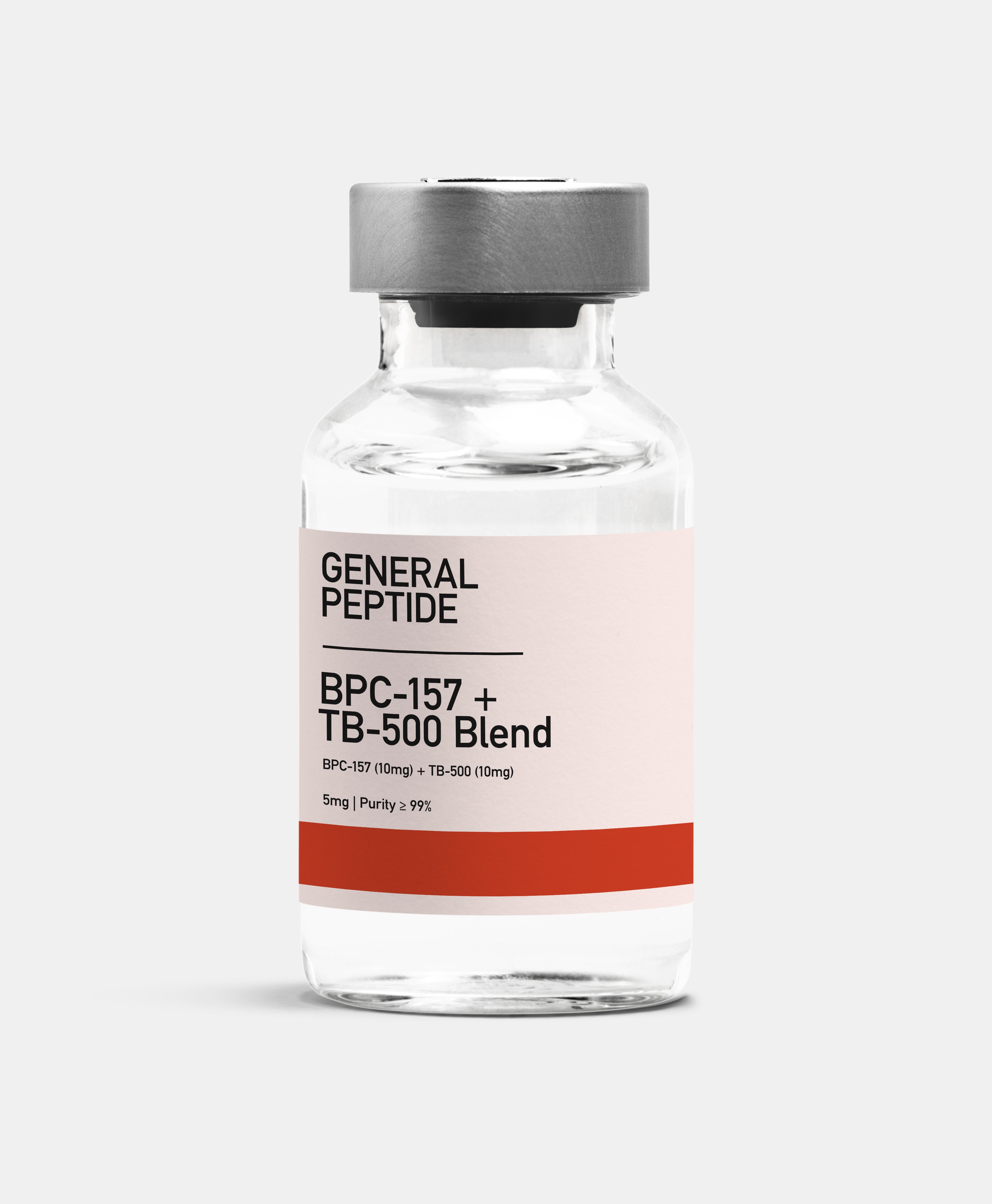
This precision-formulated dual-peptide blend brings together two of the most extensively studied tissue-repair compounds in research research. Each vial contains an equal 5mg/5mg combination of BPC-157 and TB-500, lyophilized together in a single preparation for consistent, reproducible dosing.
BPC-157 (Body Protection Compound-157) is a synthetic 15-amino acid pentadecapeptide (sequence GEPPPGKPADDAGLV; CAS 137525-51-0; MW 1419.5 g/mol) derived from a protein sequence found in human gastric juice. Its most remarkable property is exceptional stability in acidic, enzyme-rich environments — documented to remain intact in simulated gastric juice for over 24 hours. In research models, BPC-157 consistently activates the VEGF/VEGFR2-Akt-eNOS angiogenic signaling axis and modulates the nitric oxide system, producing measurable proangiogenic and cytoprotective effects across gastrointestinal, musculoskeletal, tendon/ligament, cardiovascular, and neurological injury models.
TB-500 is a synthetic 7-amino acid fragment (Ac-LKKTETQ-NH2; CAS 885340-08-9) of thymosin beta-4, specifically reproducing the actin-binding domain. By modulating G-actin to F-actin polymerization balance, TB-500 enables directional cell migration toward injury sites — a fundamentally distinct mechanism from BPC-157's vascular priming. In research models, TB-500 has demonstrated cell migration promotion, reduced fibrotic scarring, and enhanced regeneration in cardiac, muscular, ocular, and dermal injury paradigms.
The scientific rationale is mechanistic complementarity: BPC-157 addresses vascular and inflammatory microenvironment — priming new vasculature, modulating nitric oxide, engaging angiogenic growth factors. TB-500 independently drives the cytoskeletal mechanics that enable repair cells to physically migrate toward and remodel damaged tissue. Together they address sequential phases of tissue repair in a single preparation.
| Compound | Formula | MW | CAS No. | Sequence / Structure | Receptor / Target |
|---|---|---|---|---|---|
| BPC-157 | C62H98N16O22 | 1419.5 g/mol | 137525-51-0 | GEPPPGKPADDAGLV | 15-AA pentadecapeptide; NO/VEGF modulator |
| TB-500 (Thymosin β4 fragment) | C38H68N10O14 | ~1019 g/mol | 885340-08-9 | Ac-LKKTETQ-NH2 | 7-AA actin-binding fragment; cell migration facilitator |
The following compounds operate through distinct, non-overlapping mechanisms that complement this product's research pathways. Each is independently available from the General Peptide catalog.
GHK-Cu is a naturally occurring tripeptide-copper complex that acts as a powerful genetic modulator, influencing over 4,000 human genes related to tissue repair and anti-aging. It functions by activating matrix metalloproteinases (MMPs) and sti...
GLOW Blend is a precision-formulated 70mg triple-peptide complex combining BPC-157, GHK-Cu, and TB-500 for comprehensive tissue repair research. By uniting three distinct mechanisms, it addresses sequential regenerative phases. BPC-157 primes t...
NAD+ is a vital dinucleotide coenzyme present in all living cells, central to cellular energy, DNA repair, and signaling. It fuels ATP production and acts as the rate-limiting substrate for Sirtuins, PARPs, and CD38 enzymes. Because NAD+ levels...
Thymalin (Thymulin; CAS 66017-93-4; MW 857.9 g/mol) is a 9-amino acid zinc-dependent polypeptide bioregulator produced by the thymus gland that restores thymic microenvironment function and normalizes T-lymphocyte and B-lymphocyte counts. Disti...
Epithalon is a highly stable synthetic tetrapeptide modeled after a natural pineal gland polypeptide. It functions as a potent telomerase activator and bioregulator, working to elongate telomeres, extend cellular replicative lifespan, and norma...