AOD-9604
AOD-9604 (CAS 221231-10-3) is a synthetic 16-amino acid peptide fragment of human growth hormone (residues 176-191) engineered to isolate HGH's lipolytic activity while eliminating growth-promoting, IGF-1-raising, and insulin-disrupting properties. It specifically activates beta3-adrenergic receptors to stimulate lipolysis and inhibit lipogenesis in adipocytes without affecting growth hormone receptors, IGF-1 signaling, or insulin regulation. Functionally equivalent to HGH Fragment 176-191, AOD-9604 reached Phase IIb clinical trials (META0021) with a side effect profile indistinguishable from placebo. This makes it arguably the lowest side-effect weight-related research compound available, ideal for investigating adipocyte metabolism, body composition, and fat mobilization without systemic hormonal disruption.
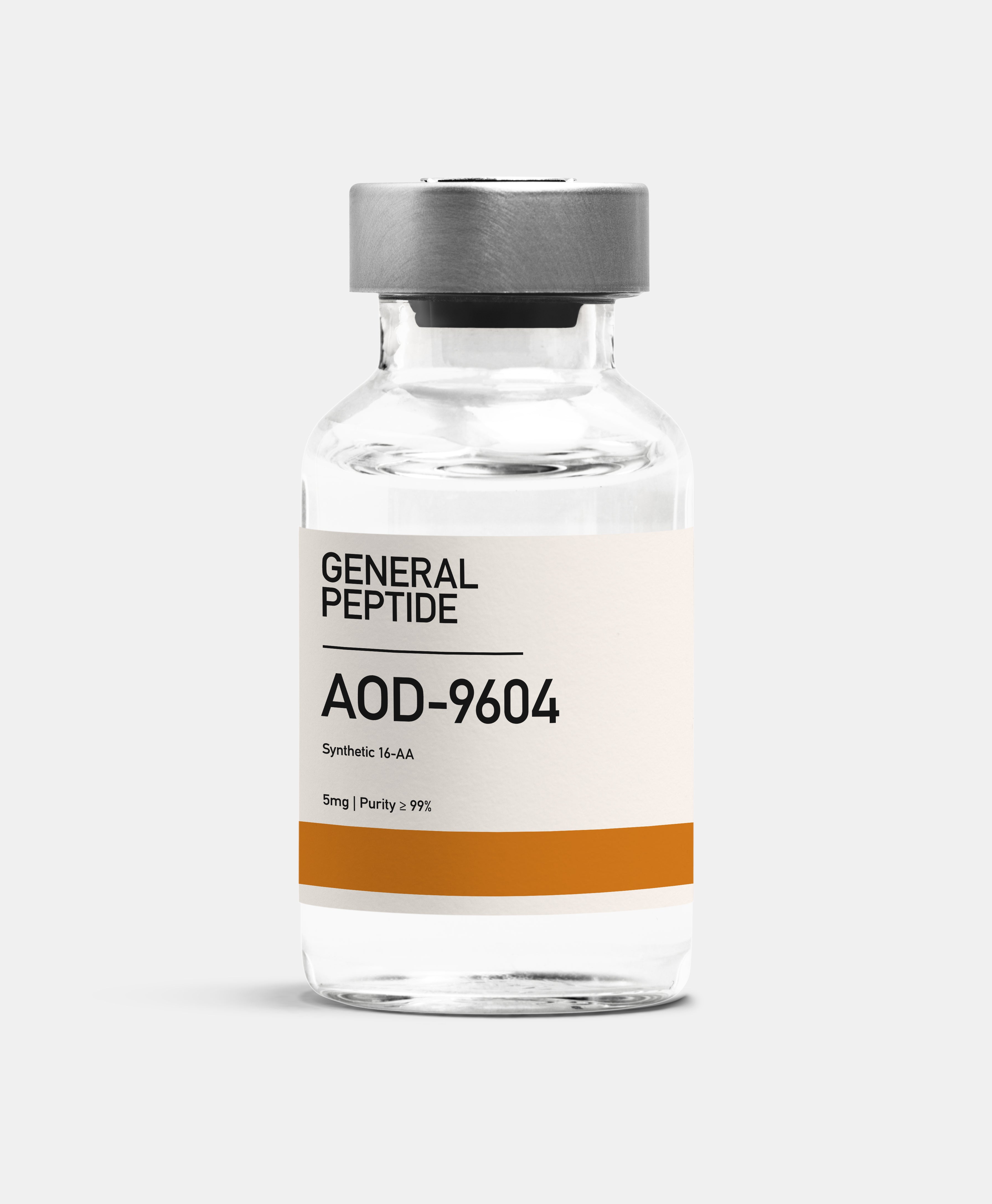
AOD-9604 (Anti-Obesity Drug 9604; CAS 221231-10-3) is a synthetic 16-amino acid peptide fragment of human growth hormone spanning residues 176-191 — the specific C-terminal sequence responsible for HGH's lipolytic (fat-burning) activity. It was engineered to isolate and amplify the fat metabolism effects of HGH while eliminating its growth-promoting, IGF-1-raising, and insulin-disrupting properties. This targeted mechanism makes AOD-9604 arguably the lowest side-effect weight-related research compound in this catalog. Unlike GLP-1 agonists (which carry GI side effects — nausea, vomiting, diarrhea) and unlike HGH itself (which raises IGF-1, alters glucose metabolism, and carries carcinogenic risk at high doses), AOD-9604 specifically activates beta3-adrenergic receptors to stimulate lipolysis and inhibit lipogenesis in adipocytes — without touching the growth hormone receptor, IGF-1 signaling, or insulin regulation. Developed by Metabolic Pharmaceuticals Ltd, it reached Phase IIb clinical trials in obesity (META0021). Side effect profile in clinical trials was indistinguishable from placebo for most endpoints. Note: AOD-9604 and HGH Fragment 176-191 are functionally equivalent — the same peptide sequence by different naming conventions.
This 16-amino acid fragment represents the minimal active sequence required for growth hormone's fat-burning effects, isolated from the full 191-amino acid hormone. By focusing exclusively on the lipolytic domain, AOD-9604 provides a precision tool for investigating adipocyte metabolism without the systemic effects of full-length growth hormone. The peptide functions through beta3-adrenergic receptor activation, triggering intracellular signaling cascades that enhance lipolytic enzyme activity while simultaneously suppressing lipogenic pathways.
In research applications, AOD-9604 demonstrates selective action on adipose tissue, promoting triglyceride breakdown into free fatty acids while inhibiting new fat synthesis. The mechanism operates independently of growth hormone receptors, IGF-1 production, and insulin signaling, making it ideal for isolating lipolytic mechanisms from other endocrine pathways. Clinical trials documented an exceptional safety profile with side effects indistinguishable from placebo, reflecting the compound's targeted mechanism and lack of systemic hormonal disruption.
The equivalence between AOD-9604 and HGH Fragment 176-191 provides researchers flexibility in nomenclature while working with the identical 16-amino acid sequence. This makes it valuable for body composition research, adipocyte biology investigation, and studies examining fat metabolism without the confounding variables of growth-promoting or glucose-modulating effects.
| Compound | MW / Formula | CAS No. | Sequence / Structure | Receptor / Target |
|---|---|---|---|---|
| AOD-9604 (HGH Fragment 176-191) | ~1817 g/mol | 221231-10-3 | 16-AA C-terminal HGH fragment (residues 176-191); same as HGH Frag 176-191 | Beta3-adrenergic receptor agonist; lipolysis stimulator; lipogenesis inhibitor; no IGF-1 or GH receptor activity |